

You commissioned student research, spent weeks analyzing responses, and uncovered fascinating patterns about what drives enrollment decisions. The insights felt like a breakthrough—until you tried translating them into campaigns. Months later, your paid ads look remarkably similar to what you were running before the research, and your cost per enrollment hasn’t budged. The plateau persists, even though you have more student data than ever.
This gap between insight and execution is where most research-driven marketing efforts stall. The problem isn’t a lack of data or poor research. It’s that most marketers use research to confirm their current approach rather than to find a reason to change it entirely.
The Evolution of Education Marketing
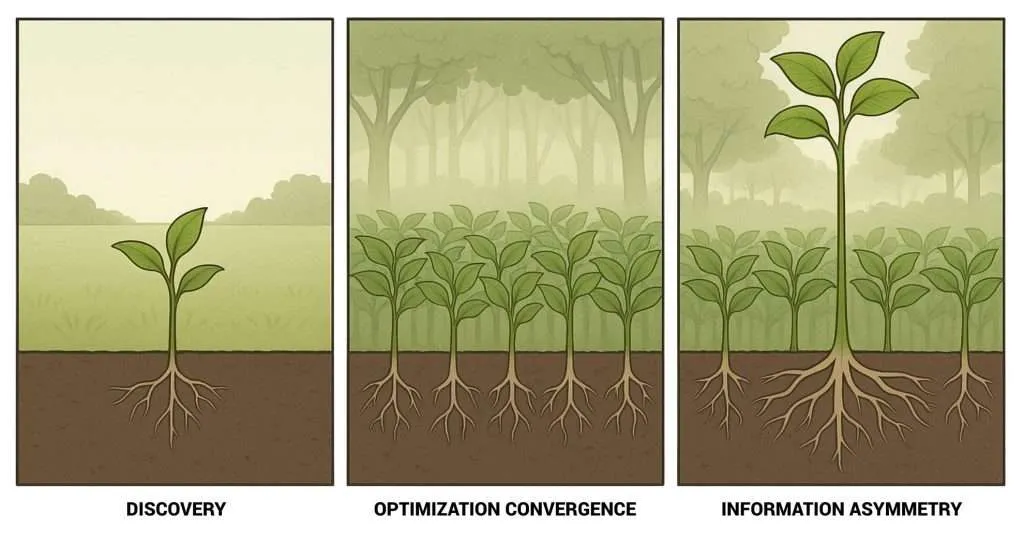
To understand why research fails to move the needle, we must recognize the evolution of marketing sophistication in this competitive landscape. Most education providers (including yours!) have journeyed through distinct phases.
In the initial stage of discovery, marketers learn that paid advertising works. They figure out how to identify audiences, test creative approaches, and optimize for conversions. Success feels achievable and scalable, and it’s where most programs find their initial growth.
The challenge begins in the phase of optimization convergence. As more providers master paid traffic, competition intensifies. Everyone optimizes toward similar goals, tests comparable creative formats, and targets overlapping audiences. Costs rise while conversion rates plateau. This is the sophisticated, yet stuck, place where most programs currently find themselves. Your campaign is technically proficient, but its approach is undifferentiated and it’s struggling to drive results.
For example, your program might have initially found great success with ads targeting “project management certification” and “PMP training.” Now, your competitors are running similar ads with similar claims about passing rates and flexible schedules, all of you bidding on the same keywords. You’re all technically proficient, but your approach is undifferentiated and is struggling to drive results because you’re fighting for the same sliver of attention.
The breakthrough occurs when a program reaches a state of information asymmetry. This is the rare, breakthrough phase that involves using insights that competitors either don’t have or can’t effectively implement. Here, student insights become a multiplier rather than just supporting evidence. Programs operating at this level use research to make fundamentally different strategic decisions, not just refine existing tactics.
The Problem with “Actionable” Insights
Most education marketing research produces insights that sound actionable but actually aren’t. Consider these common findings: students prioritize practical skills over theoretical knowledge, they want flexibility in their learning schedule, or they’re motivated by career advancement opportunities. These insights feel valuable because they’re specific and measurable. Yet they lead to predictable campaign adjustments that every competitor can replicate.
The issue isn’t the research quality. It’s that these insights operate within existing frameworks rather than challenging them. When research reveals that students care about outcomes, most marketers respond by emphasizing outcomes more prominently in their messaging. They adjust the what without questioning the how, where, or when of their entire approach.
This creates what appears to be research-driven marketing but actually represents sophisticated guesswork. The campaigns become more polished versions of previous campaigns, optimized around insights that every thoughtful competitor could reach through basic market observation.
The Translation Problem: From Insight to Operation

The gap between compelling research findings and transformative campaigns reveals itself in how education marketers interpret actionable data. Most respond to the insight that students research extensively by creating more content or longer nurture sequences.
But operational thinking asks different questions: If students are researching extensively, what does that suggest about their decision-making anxiety? Are they genuinely uncertain, or are they procrastinating on a decision they’ve already made emotionally? Does more information actually help, or does it create additional friction?
These questions lead to different strategies. Instead of feeding the research behavior, you might create campaigns that acknowledge the anxiety driving it. Rather than positioning your program as the obvious choice, you might address the psychological barriers that make the decision feel so consequential. The same insight produces entirely different strategic responses depending on whether you’re optimizing within your current framework or questioning the framework itself.
The Operational Framework: Research as a Strategy Driver
Research-driven marketing becomes transformative when insights directly influence strategic decisions rather than tactical refinements. This requires frameworks that connect data to campaign architecture, not just messaging adjustments.
Start by identifying assumptions your current campaigns make about student behavior, decision timelines, or competitive positioning. Most education marketing operates on inherited assumptions about how enrollment decisions happen, many of which haven’t been tested against actual student data.
Use research to stress-test these assumptions rather than confirm them. If your campaigns assume students compare programs systematically, test whether students actually engage in structured comparison or make decisions through different cognitive processes. If your messaging emphasizes program features, investigate whether students process that information differently than outcome-based information during their decision journey.
The operational approach treats every insight as a potential reason to restructure campaigns from the ground up. Rather than improving existing elements, you’re questioning whether those elements should exist at all.
The Compound Advantage
Programs that successfully use research-driven marketing create a compounding advantage that goes beyond better ad performance. Their messaging resonates more because it speaks to students’ actual concerns, not just what marketers assume they want. Their conversion paths work more efficiently because they match how real people make decisions, not just an ideal sales funnel.
More importantly, this approach builds a marketing “muscle” that gets stronger over time. Each research cycle makes the team faster at spotting strategic insights and more skilled at turning them into campaigns that competitors can’t easily copy.
The true competitive advantage isn’t the research itself. Rather, it’s the organizational ability to consistently transform insights into a strategic edge. This is why some education programs seem to effortlessly stay ahead of market shifts while others constantly chase trends, even when they have access to similar information.
Research as Strategic Infrastructure
The most sophisticated education marketers treat research as strategic infrastructure rather than campaign input. They use student insights to inform fundamental decisions about positioning, timing, channel selection, and competitive strategy. Research becomes the foundation for systematic competitive advantages rather than tactical improvements.
This requires viewing data not as confirmation of current approaches but as raw material for strategic alternatives. The goal shifts from optimizing campaigns to rebuilding them according to principles that competitors either don’t understand or can’t easily copy.
When research functions at this level, the resulting campaigns don’t just perform better—they perform differently. They operate according to strategic logic that creates sustainable advantages in increasingly competitive education markets.

Manno Notermans
I’m Manno, co-founder and CSO at Think Orion. I work with universities, exam prep companies, and course creators to use insight-led marketing that reflects how people choose what to learn. Most of my work comes down to understanding those choices and helping education brands align with them. At Think Orion, we use research, creative strategy, and clear systems to help good programs reach the right students.
View LinkedIn profile