


We’ve all been there. A campaign shows dream-level CTR and CPC, and the report looks great on paper. But enrollments are flat, and bounce rates hover around 90%. This isn’t just bad luck. It’s often a student ad-message mismatch, where the promise in your ad never aligns with what students believe when they land on your page.
The paradox is a frustrating one: a funnel that’s seemingly “healthy” on the surface is hemorrhaging potential students. This isn’t a matter of tweaking your ad bids or adjusting the CTA button. The problem isn’t a technical flaw in the funnel itself; it’s a deeper misalignment that happens before a student even clicks. The funnel is a symptom of a much larger strategic issue. There’s often a gap between what you’re promising and what your prospective students actually believe.
The Belief Gap: When Personas Skip Psychology
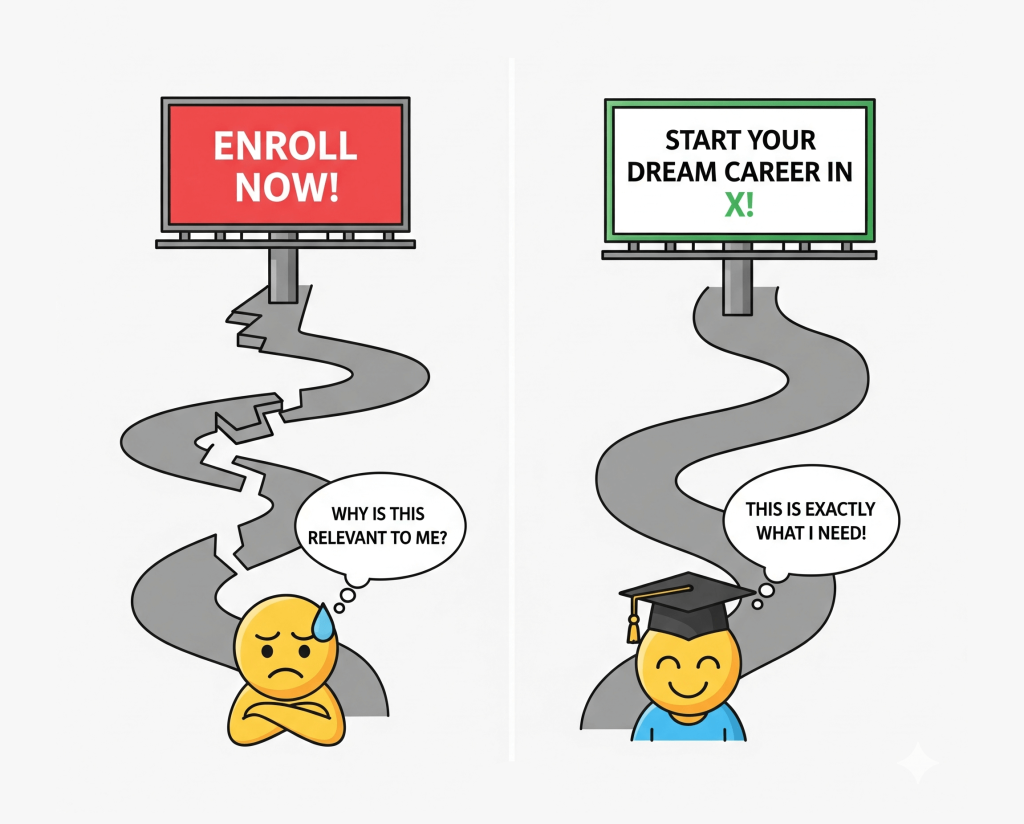
Many of our enrollment funnel mistakes start with research that never gets deep enough. We build campaigns on demographic profiles and surface-level personas: “45-year-old marketing manager, lives in a suburban area, looking for a career change.” This data tells us who they are, but it doesn’t tell us why they might enroll in your program. It fails to surface their core belief states.
Consider a campaign for a professional certificate program, like a drone pilot certification or a project management bootcamp. The ad copy promises “fast results” and “a new career in weeks.” It’s an easy, compelling message. But what if the people you’re targeting aren’t actually driven by speed? What if they’re motivated by the credibility of the certification and the long-term stability it offers? They click the ad, land on a page that repeats the “fast” promise, and immediately bounce. The ad-message mismatch isn’t about the words on the page; it’s about the promise failing to resonate with their underlying belief that career change is a serious, long-term commitment, not a quick fix.
Without taking the time to understand these deeper drivers, your messaging defaults to generic selling points, leaving prospects feeling uninspired and misunderstood. This kind of student ad-message mismatch happens when campaigns highlight speed or cost, while students are really motivated by credibility and stability.
The MBA Ad: A Case of Student Ad-Message Mismatch
A similar kind of student marketing challenge plays out in many campaigns. An ad for an MBA program highlights a generous scholarship opportunity. A student, motivated by financial concerns, clicks. They land on a generic admissions homepage that talks about the institution’s rich history and esteemed faculty…the very things your internal stakeholders are most proud of!
The bounce that follows isn’t just about a poor user experience. It’s a textbook example of student ad-message mismatch: the ad promises affordability, while the landing page talks about prestige. The promised connection – the core reason the student clicked – was never delivered. The student’s mindset was “how can I afford this and make it work for me?” while the website was screaming, “Look how great our institution is!” The institution’s value proposition wasn’t aligned with the student’s personal and professional drivers. The promise never matched the student’s internal question, and the funnel breaks before they have a chance to engage.
Decision Friction in the Student’s Mind

For students, education isn’t a transactional decision; it’s an identity-driven one. Choosing to enroll in a course or program is often a significant moment of self-definition. This is where unacknowledged decision friction can derail even the most optimized funnels.
Take an engineering exam prep course or a professional licensing program like a CA certification. A student might not hesitate to enroll because of the price. They might hesitate because of a far more powerful fear: “What if I can’t pass the exam, even with this prep course?” or “What if I choose the wrong provider and waste my time and money?”
Your campaign might be focused on highlighting success rates and course features, but the student’s internal narrative is all about their own self-doubt. The why-ads-don’t-convert problem here has little to do with frequency or CTA tweaks. It’s another form of student ad-message mismatch by ignoring the doubts students carry into every enrollment decision.
Fixing the Ad-Message Gap: A System of Alignment

The most successful campaigns don’t feel like persuasion; they feel like recognition. They don’t just say, “Here’s what we offer.” They say, “We understand what you’re dealing with.”
Imagine a landing page that doesn’t just echo the ad, but the student’s self-doubt. It might open with a headline like, “Worried you’ll fail the exam again? Here’s how our students overcame that exact hurdle.” This kind of messaging builds immediate trust because it acknowledges the student’s internal narrative. This approach frames the funnel not as a pathway to conversion, but as a system of alignment that reduces friction and increases trust at every step.
Rethinking Enrollment Funnels: From Clicks to Beliefs
The next time you’re troubleshooting your enrollment funnel, shift your focus. The funnel isn’t just a series of technical steps from click to conversion. It’s a series of psychological moments, and it’s broken long before the bounce. Your most powerful lever isn’t ad tech or budget; it’s a deep, research-backed understanding of what your students believe. Campaigns that speak to these belief states and address underlying anxieties will always outperform those built on surface-level assumptions. It’s time to stop thinking of funnels as traffic engines and start seeing them as systems of resonance.

Manno Notermans
I’m Manno, co-founder and CSO at Think Orion. I work with universities, exam prep companies, and course creators to use insight-led marketing that reflects how people choose what to learn. Most of my work comes down to understanding those choices and helping education brands align with them. At Think Orion, we use research, creative strategy, and clear systems to help good programs reach the right students.
View LinkedIn profile