Remember when college recruitment meant admissions officers trekking from one high school to another with stacks of brochures and a warm smile?
That traditional student recruitment model was the backbone of higher education for decades, playing a key role in shaping university admissions and enrollment strategies.
Back then, personal interactions, face-to-face meetings, college fairs, and campus visits were the primary means to connect with prospective students.
Fast forward to today, and the landscape has radically transformed.
Modern students are digital natives who expect personalized, instant engagement long before they even set foot on campus.
According to the NSCRC, first-year enrollment dropped by more than 5% this year, with recent high school graduates dropping by more than 6%, a clear indicator that the old methods are struggling to resonate with a tech-savvy generation.
Given this, the reality is that today’s students conduct their college search online, scrutinizing every aspect through digital lenses.
This shift has compelled higher education institutions to reimagine the recruitment funnel, moving away from one-size-fits-all tactics toward data-driven strategies.
In this blog post, we’ll explore why traditional student recruitment is no longer sufficient, the changing student expectations, the role of technology and data, the rise of digital-first strategies, and the future trends emerging over time.
Key Takeaways:
- Today’s students expect AI-driven, personalized engagement rather than one-size-fits-all outreach. Generic emails and brochures are no longer effective.
- Universities that don’t embrace digital tools like AI chatbots, immersive virtual tours, and social media strategies risk falling behind in student engagement.
- With over a million international students choosing U.S. universities, institutions must differentiate themselves with unique value propositions, employer connections, and diverse student experiences.
- Combining in-person events with digital experiences (e.g., virtual campus tours, and interactive webinars) creates a seamless recruitment strategy that meets students where they are.
- Universities leveraging analytics for targeted marketing, predictive enrollment trends, and student behavior insights will have a competitive edge in attracting and retaining students.
The Limitations of the Traditional Recruitment Model
Traditional recruitment methods in higher education have long relied on college fairs, recruitment events, and printed brochures as the main tools for admissions outreach.
These marketing tactics once played a central role in boosting enrollment. However, they come with drawbacks.
For one, the scale of the challenge is immense, there are thousands of high schools across the U.S., making it practically impossible for admissions officers to visit every campus in person.
This gap means many prospective students remain unreached by these in-person events.
Moreover, insights from Inside Higher Ed highlight that Gen Z students are now more likely to rely on digital content like TikTok and virtual tours to get a “vibe check” on campuses.
This shift in behavior shows that online research has become the primary step in the decision-making process for many prospective students.
As enrollment trends and demographics shift, prospective students demand personalized, digital-first interactions, and the reliance on traditional higher education recruitment problems becomes more apparent. It is time to rethink these outdated approaches.
Changing Student Expectations and Preferences
Unlike previous generations, Gen Zs are digital natives who expect a personalized, tech-driven, and flexible recruitment experience that goes far beyond traditional college fairs and printed materials.
They prioritize digital communication and virtual interactions, relying heavily on social media and online content to decide if a school fits their needs.
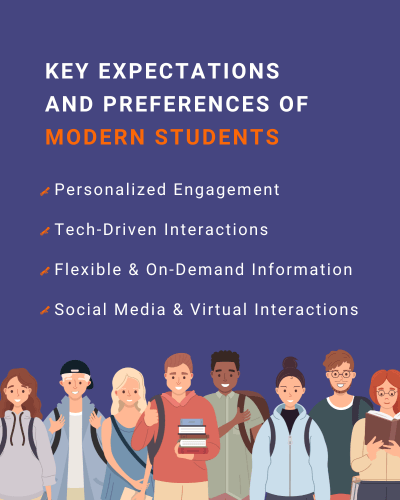
Here are some key expectations and preferences of modern students:
1. Personalized Engagement
Gen Z students demand communication that speaks directly to their interests.
That said, 76% of people now expect personalized experiences and get frustrated when brands don’t deliver.
Rather than receiving generic messages, they expect tailored outreach based on their online behavior and academic goals.
As a cohort, they combine their pragmatic nature with a need for instant gratification. Thus, their success in conveying meaningful messages in a personalized way is driven by emotional resonance.
Given this, colleges and universities have been trying for some time now to personalize their interactions with prospective students, using data and analytics to craft more relevant experiences throughout the enrollment funnel.
2. Tech-Driven Interactions
Digital fluency is a given for Gen Z. They expect innovative, tech-driven recruitment experiences that leverage the latest education technology.
Virtual tours, for example, have become essential tools for assessing campus culture and facilities, replacing initial in-person visits.
Data from EAB shows that virtual college tours have surged in popularity, with a 258% increase in participation among high school seniors.
Studies also indicate that students who explore campuses through virtual tours are more likely to apply, with some institutions reporting application rates rising by up to 67% as a result.
These tech-enabled interactions allow students to explore campus life from anywhere and anytime, following a digital-first approach in university recruitment.
3. Flexibility and On-Demand Information
Modern students value flexibility and access to information 24/7 that fits their busy, often non-traditional schedules.
Virtual tours and self-guided online experiences enable students to engage with campus content at their own pace.
Also, a significant portion of prospective students prefer on-demand digital resources that allow them to research and compare institutions without being tied to fixed schedules.
4. Reliance on Social Media and Virtual Interactions
According to Google's internal data, nearly 40% of Gen Z prefers searching on TikTok and Instagram over Google Search and Maps.
That said, social media has become a significant influence on Gen Z's college selection process.
With platforms like TikTok shaping perceptions of campus life, aesthetic appeal has become as important as academic reputation.
Based on data from Business Insider, college-bound Gen Z students are increasingly choosing schools based on how well campus life translates to social media, evidenced by the staggering 30+ billion views on the #collegelife hashtag.
When it comes to deciding on a school, these TikToks show parts of college life that previous generations had little access to and often didn't discover until their freshman year, after the decision of where to go had been made.
Together, these trends highlight a seismic shift toward digital university recruitment, where personalized, tech-driven, and flexible engagement strategies are no longer optional but essential.
The Role of Technology and Data in Recruitment
Technology and data have transformed college recruitment by enabling institutions to move from broad, generalized outreach to highly targeted, tech-driven strategies.
Tech and data allow universities to track prospective student behavior online in real-time, tailoring communication and improving conversion rates through data-based insights.
Here are key ways universities are leveraging technology and data in recruitment:
1. Leveraging AI in Student Recruitment
AI enables educational priorities to be achieved in better ways, at scale, and with lower costs.
Also, a study revealed that using natural language processing (NLP) to deliver timely and specific feedback enhances student learning and engagement.
Therefore, colleges and universities use AI recruitment tools to provide prospective students with personalized support and interactive experiences.
For example, California State University has implemented an AI by deploying an intelligent chatbot known as "CSUNny."
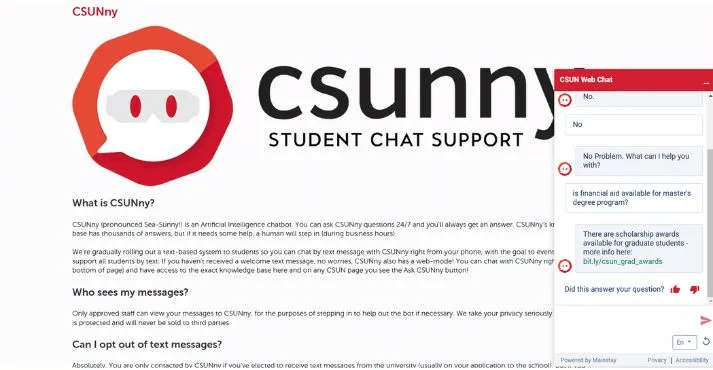
Source: CSUN
AccCSUNny, accessible on the university website and Facebook Messenger, CSU is a virtual assistant that streamlines a range of administrative tasks.
It offers real-time responses to frequently asked questions regarding enrollment deadlines, financial aid options, and campus resources.
This innovative use of an education chatbot shows how AI revolutionizes college recruitment by enhancing efficiency, improving student engagement, and creating a smoother transition from inquiry to enrollment.
2. Implementing CRM for University Recruitment
The National Student Clearinghouse Research Center study shows that nearly 39% of first-time, full-time bachelor’s students drop out, highlighting the need for proactive support.
Given this, implementing modern CRM systems will help universities gather enrollment data and track student interactions across multiple channels.
CRM systems help colleges track engagement, grades, and attendance, allowing timely interventions to improve retention and student success.
Utah State University (USU) launched OneUSU CRM, an AI-powered system using Salesforce Education Cloud to enhance student recruitment.
The platform unifies student data, streamlines admissions, and personalizes outreach. It connects prospective students with advisors, tracks engagement, and automates follow-ups to improve conversion rates.
With timely, data-driven communication, this initiative boosts enrollment and creates a student experience from recruitment to alumni engagement.
3. Utilizing Predictive Analytics
Predictive analytics allow institutions to analyze historical enrollment data and forecast student behavior, identifying high-propensity applicants who are more likely to convert.
The University of Idaho leveraged data analytics to improve student success, focusing on data governance and predictive modeling.
By doing so, they analyzed trends and shifted toward need-based financial aid, helping more students afford education. Advanced analytics also provided insights into student behaviors, enhancing recruitment and retention strategies.
This data-driven approach helps allocate recruitment resources more efficiently and enhances conversion rates by focusing on candidates with the highest likelihood of enrollment.
4. Automating Marketing and Outreach
Automation tools enable colleges to run personalized, multichannel campaigns without overwhelming their staff.
For example, the UW–Madison leverages data-driven marketing to automate communications and engagements across various media channels, thereby saving time, boosting effectiveness, and eliminating redundancy.
That said, the data and interactions allow different departments to create highly relevant messages that resonate with prospective and current students.
For this, the university utilizes Eloqua, an Oracle product, to execute mass email marketing campaigns and sophisticated, automated marketing workflows.
This platform enables sending graphic, trackable emails to both on- and off-campus recipients, with recipient lists segmented by demographics or engagement behavior.
Additionally, Eloqua tracks website visits and email interactions through detailed dashboards and reports, providing actionable insights that continuously refine UW–Madison’s outreach strategies.
Given the role of technology and data in recruitment, tracking student behavior, from website interaction metrics to social media engagement, allows universities to continually refine their digital marketing strategies.
This tech-driven approach not only improves conversion rates but also creates a more dynamic and responsive recruitment process that resonates with modern student expectations.
The Rise of Digital-First Recruitment Strategies
Digital-first recruitment strategies have become essential in meeting modern student expectations.
In the past, they relied on traditional methods like buying student contact lists or hosting in-person events.
However, these approaches are no longer enough. Colleges must now focus on digital strategies to reach and engage students.
Given that, digital-first has become the way for colleges and universities to share their culture, build real connections, and create relationships with future students.
Here are the most commonly adopted digital-first strategies for higher education institutions:
1. Social Media Marketing
Platforms like Instagram, Facebook, YouTube, and LinkedIn help universities connect with students where they spend most of their time.
Based on insights from a Pew Research Center study, these platforms are the most popular among adults, with TikTok growing quickly.
Therefore, colleges must share content such as campus life videos, student testimonials, and behind-the-scenes looks at academic events. This will help colleges and universities to create engaging narratives that resonate with digital natives.
The more buzz you create, the better your reach.
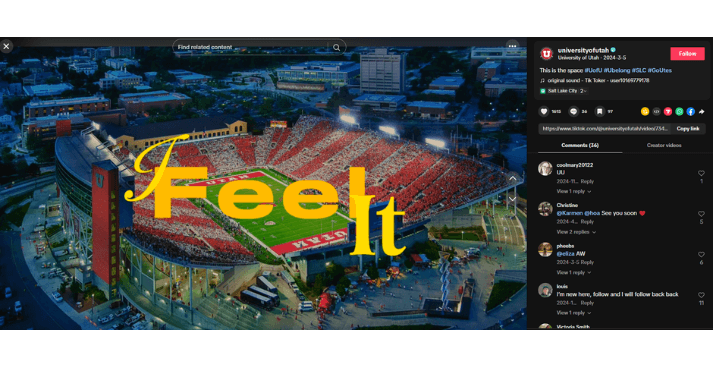
Source: TikTok
The University of Utah is a perfect example of how institutions use social media to build community and showcase campus culture, buildings, and surroundings that create the whole vibe.
2. Influencer Partnerships
Influencer collaborations enable institutions to leverage the trust and relatability of student ambassadors and popular content creators.
When current students or alumni share authentic experiences on social media, they offer a peer perspective that prospective students value.
For example, Sienna Santer, a Harvard student (now an alumnus) began sharing her experience through campus videos in 2018.
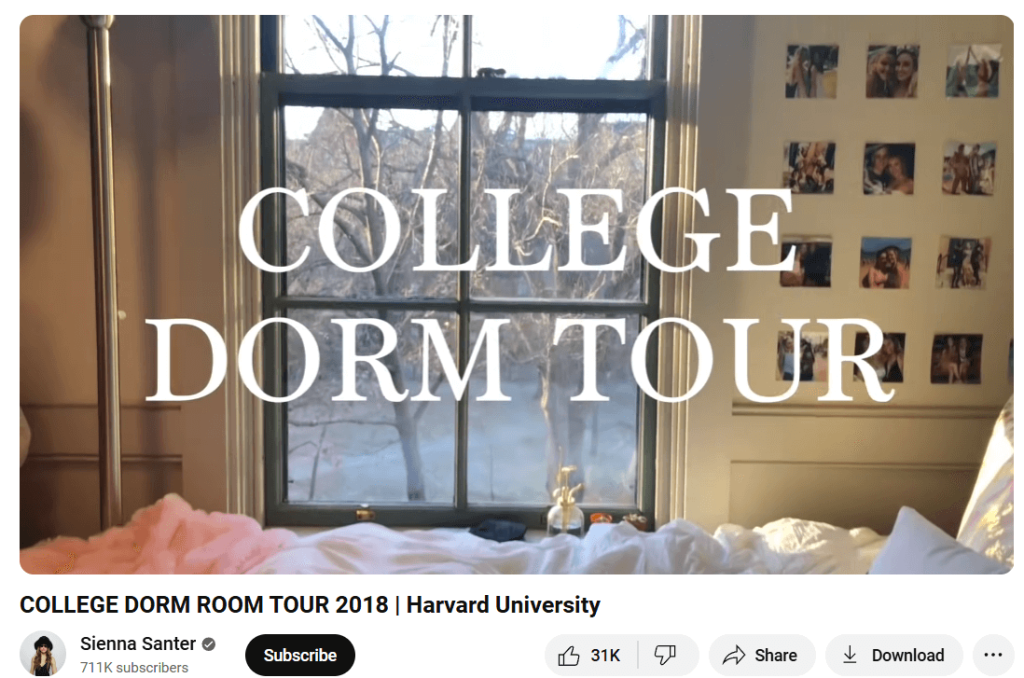
Source: YouTube
Since then, through her authentic and relatable posts, Santer has challenged stereotypes and illustrated that Harvard students can be both academically serious and trendy, making her an excellent example of an influencer partnership in higher education recruitment.
Given this, universities partnering with social media influencers can help increase the flux of inquiries, as these influencers show the real-life benefits of their programs.
3. Interactive Websites
Interactive websites are transforming the college search by offering personalized, user-driven experiences.
For example, some universities use tools that let prospective students select areas of interest (e.g., study abroad, specific majors) to receive customized information, thus enhancing digital engagement and boosting conversion rates.
In addition to this, keep your college website menu short and simple for user-friendly navigation.
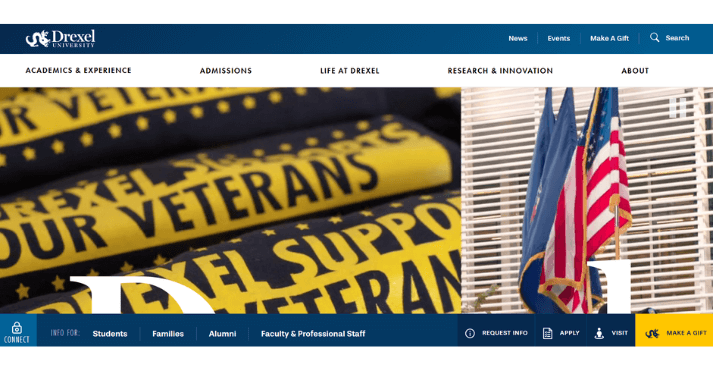
Source: Drexel University
For example, Drexel University's website design includes interactive storytelling through visuals. The site features a video in the first section that narrates the university's brand story, offering an engaging and immersive experience.
4. Virtual Reality Tours
Virtual reality (VR) tours have emerged as a game-changer in recruitment. They provide immersive campus experiences without requiring physical visits.
These 360° tours enable students to explore facilities, attend virtual info sessions, and gain a feel for campus life from anywhere in the world.
With features that allow users to click on different areas for more information, VR tours act as effective engagement tools.
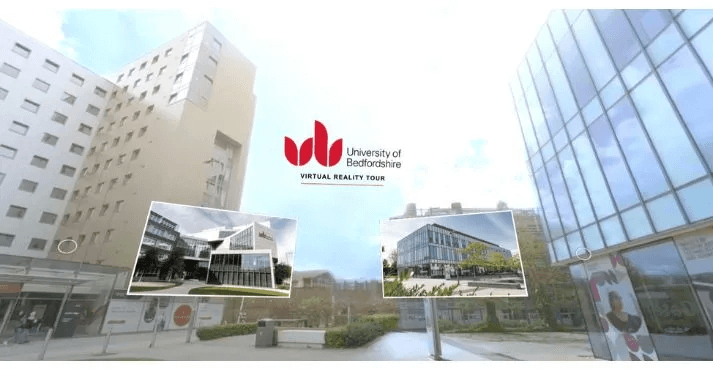
Source: University of Bedfordshire
For example, the University of Bedfordshire has introduced an immersive 360-degree virtual reality (VR) campus tour, allowing prospective students to explore campus life remotely.
This innovative tool provides an engaging experience, enabling users to navigate facilities such as nursing simulation labs and performing arts theaters from their own homes.
Global Competition and the Need for a Differentiated Approach
Universities worldwide are competing for top talent, driven by globalization and the internationalization of higher education.
According to UNESCO’s Institute for Statistics, the U.S. is still the top choice for international students.
In the 2023/2024 academic year, the United States hosted 1,126,690 international students from over 210 countries, marking a 7% increase from the previous year.
According to the U.S. Department of Commerce, international students contributed $50 billion to the U.S. economy in 2023, primarily through tuition fees and living expenses.
While countries like the U.K., Canada, and Australia are strong competitors, the U.S. remains the top choice for students worldwide.
Countries like China and India continue to be leading sources of these students, reflecting the sustained demand for quality education.
This competition has led institutions to develop unique value propositions, establish connections, and offer diverse student experiences to remain appealing.
Consequently, this upward trend in higher education enrollments at national and international level signifies why universities are adopting various strategies to differentiate themselves.
To stand out, universities are adopting several key strategies:
- Unique Value Propositions: Institutions differentiate themselves by emphasizing distinctive academic programs, research opportunities, and campus cultures.
- Employer Connections: Establishing strong ties with industries enhances employability prospects for graduates.
- Diverse Student Experiences: Offering inclusive and supportive environments caters to a broad spectrum of students.
To remain attractive, institutions must continually innovate and adapt as the potential for growth continues to expand the recruitment efforts.
The Future of Student Recruitment: Key Trends and Solutions
The future of student recruitment is rapidly evolving as U.S. institutions embrace next-gen recruitment strategies driven by technology and data.
With new technologies and shifting student expectations, students now have more power than ever to choose when and how to connect with universities.
Here are some of the key trends of the future student recruitment:
1. AI-Driven Personalization
In the future, AI will become even more sophisticated, predicting what students need before they even ask.
As competition grows, more colleges are using AI technology to make admissions and student recruitment more efficient. AI also helps schools connect with students quickly, leading to better engagement and higher satisfaction.
For example, Leeds Beckett University uses an AI chatbot named "Becky" to help prospective students.
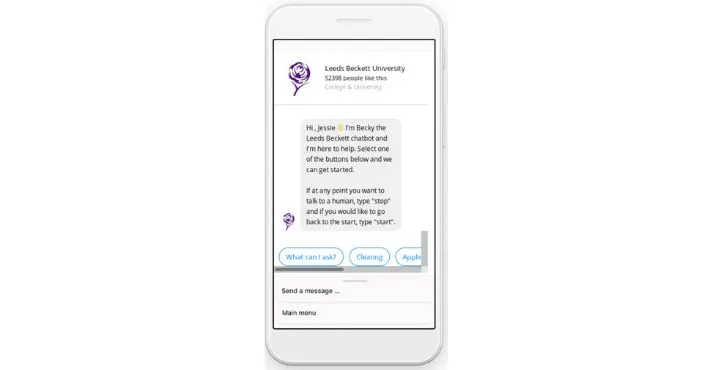
During office hours, Becky provides information on courses, entry requirements, fees, scholarships, and accommodation through Facebook Messenger, making it easier for students to get quick answers.
Many institutions have seen more students move from inquiries to enrollment thanks to real-time, personalized support.
AI also helps schools save money by handling routine tasks, especially during busy enrollment periods. This allows staff to focus on providing better services to students.
2. Immersive Experiences
As technology advances, immersive experiences will become even more realistic and accessible.
Universities are providing access to virtual open days, during which students can not only explore the campus but also interact with current students and faculty in real time, making the decision-making process more exciting.
For example, Northwood University now offers a new interactive campus map and virtual tour, making exploring the campus fun and easy for prospective students, families, and visitors.
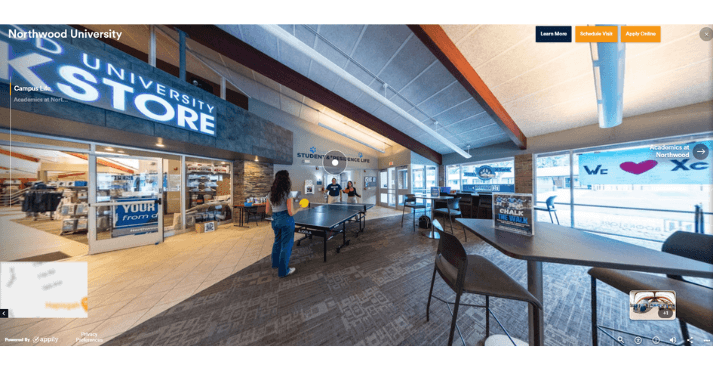
Source: Northwood University
What makes such tours special is the AI-driven personalization, which tailors the tour to your interests and needs.
Moreover, students can also hear real stories through student and alumni testimonials. Plus, the tour is seamlessly integrated with inquiry forms, so you can quickly request more information, schedule a visit, or even apply, all in one smooth experience.
3. Gamification
According to Statista, the global gaming market will amount to 503.14 billion U.S. dollars annually in 2025, highlighting the increased interest among people.
Given this, implementing gamification in higher education can be achieved through methods like leadership boards, quizzes, simulations, badges, and collaborative challenges.
As a result, the fun elements of gamification will get more creative and interactive as the storyline will help students learn about different aspects of college life.
This will keep students engaged and help them understand the school culture in a fun and memorable way.
4. Hybrid Recruitment Models
Hybrid recruitment models combine digital and in-person strategies to meet prospective students' evolving needs.
With digital tools such as AI-driven chatbots, interactive virtual tours, personalized email campaigns, data analytics, and traditional face-to-face interactions like campus tours, open houses, and information sessions, institutions can offer a seamless and personalized recruitment experience.
This integrated approach allows universities to capture initial interest through digital channels and deepen engagement with in-person events, ensuring that every prospective student receives timely, relevant, and human-centered communication.
What’s new in these models is the focus on creating a continuous, unified journey for students.
Digital insights track online behavior and preferences, enabling admissions teams to tailor follow-ups and schedule personalized on-campus visits.
For example, a student might start by exploring a university’s virtual tour, engage with an AI-powered chatbot for immediate answers, and later attend an in-person event where they can ask detailed questions.
Therefore, this hybrid approach improves conversion rates and nurtures leads, reducing staffing burdens during peak enrollment periods while maximizing the student experience.
Conclusion
Given changing student demographics and technological advancements, adapting to modern recruitment methods isn’t just a convenience; it is a necessity.
Today’s prospective students begin their college search online, expecting personalized, instant, and interactive experiences.
Therefore, universities that invest in innovative tools like AI-powered chatbots, immersive virtual tours, and integrated CRM systems are better equipped to meet these expectations.
Moreover, with data-driven strategies, institutions can track real-time student behavior and tailor their communications to each individual’s interests.
This personalized approach improves engagement and boosts conversion rates by ensuring that every touchpoint, from digital ads to campus visits, speaks directly to the student’s needs.
That said, it’s a more efficient way to convert inquiries into enrollments and to build lasting relationships that continue well into the alumni phase.
See how we help with student recruitment

Manno Notermans
I’m Manno, co-founder and CSO at Think Orion. I work with universities, exam prep companies, and course creators to use insight-led marketing that reflects how people choose what to learn. Most of my work comes down to understanding those choices and helping education brands align with them. At Think Orion, we use research, creative strategy, and clear systems to help good programs reach the right students.