Education technology is changing how students reach, enroll, and study.
Computer-aided learning introduces information communication technologies to learning to create a more inclusive student experience.
With more powerful edtech industry trends, the potential has been recognized by businesses, and they continue to invest more and more.
Edtech offers numerous benefits, some of which include:
- Immersive learning
- Accessibility and flexibility
- Personalized education experience
- Higher student engagement
- Fosters collaboration
Even though classroom learning has gained momentum, technological trends in teaching and learning will continue.
In this blog, we will be exploring the following industry and market trends for edtech companies:
- Personalized learning
- Online and blended learning
- Gamification and immersive learning
- Data analytics and learning analytics
- EdTech in K-12 Education
- EdTech in Higher Education
- EdTech for Corporate Training
Current Landscape of the EdTech Industry

The latest edtech trends are driving the current landscape of the industry. The growth of online education continues to expand rapidly as the number of internet users stood at 5.19 billion in 2023.
Market size and growth statistics
With growing digitalization globally, the global e-learning market is forecast to reach almost 400 billion U.S. dollars by 2026.
Forecasts suggest that the education software market will continue for years, reaching 11.6 billion dollars by 2025.
Worldwide spending on edtech is expected to increase dramatically. The global Edtech and intelligent classroom market size is projected to reach USD 433.17 billion by 2030, at a CAGR of 18.3%.
Key players in the EdTech industry
The industry continues to evolve as educational institutions invest in edtech to access and manage educational resources.
According to the data published by Statista, the top ten critical players in the edtech industry are:
- Byju’s
- BetterUp
- Guild Education
- Articulate
- Course Hero
- Handshake
- GoStudent
- UnAcademy
- Erudits
- ApplyBoard
Global reach and accessibility of EdTech solutions
Edtech solution connects educators and students across borders, fostering international collaboration and knowledge sharing.
By leveraging digital marketing for universities, edtech platforms transcend geographical boundaries, enabling students worldwide to access high-quality educational resources.
The global accessibility of edtech paves a more inclusive and interconnected learning landscape for individuals to pursue higher education.
So, what are the new trends coming in 2023 and beyond? Here’s what you need to know.
Key Trends in the EdTech Industry
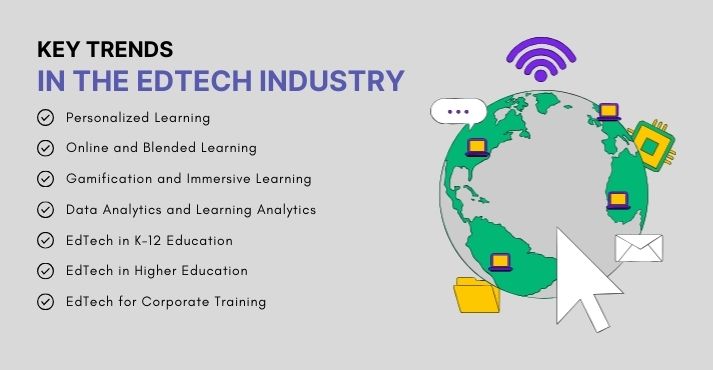
Edtech has the power to improve learning outcomes for hundreds of people worldwide. According to Global Market Insights, the e-learning market in 2028 will exceed $1 trillion.
Let’s look at the higher education marketing trends that will transform the industry in the future.
A. Personalized Learning
Personalization is fast becoming the baseline for the higher education industry. The one-size-fits-all approach isn’t suitable for students anymore. Students have different learning styles and are attracted by various elements; hence, institutions should take notice of this changing trend.
1. Adaptive learning platforms
Adaptive learning is a personalized strategy that is especially valuable in environments with diverse learners, such as classroom or corporate training programs.
For example, imagine if you are a student stuck on a math word problem and can’t immediately get help from your teacher or classmates. Adaptive learning will allow you to watch videos about what you need to unblock the understanding and complete the math word problem.
2. AI-driven personalized recommendations
Adaptive learning platforms use innovative tools such as artificial intelligence to analyze a learner's performance and adapt the curriculum accordingly.
In the context of content marketing for edtech, adaptive learning platforms offer a compelling value proposition and cater to diverse learning styles. The adoption of transformative educational technologies will also enhance edtech brand visibility.
B. Online and Blended Learning
Gone are the days when online learning was a mere choice or a privilege. It has become a necessity for students and professionals.
1. Growth of online education platforms
According to Statista, the number of users in the online learning platforms market is expected to amount to 4.8 million by 2027, with a penetration of 1.4% in 2023. It is expected to hit 1.9% by 2027.
2. The role of blended learning models
Today, students and educators agree on the efficacy of the blended learning method as it combines the effectiveness of in-class learning and online, saving time and delivering a more personalized knowledge acquisition.
C. Gamification and Immersive Learning
Gamification and immersive learning experiences are two powerful tools that deliver exceptional results. When combined, gamification and immersive learning are digital twins that allow students to interact in a simulated environment.
Many technologies, such as 360-degree videos, simulations, and tutor-based learning, are examples of immersive learning environments.
1. Gamified learning experiences
Gamified learning experiences drive higher student engagement. Adding fun, engagement, and healthy competition elements can make education more interactive.
Edtech platforms will incorporate elements of games like scorecards, leaderboards, and trophies into educational modules and courses.
Benefits of gamified learning experiences:
- Higher levels of engagement
- It makes learning fun and interactive
- Improved knowledge retention
- Instant feedback and reinforcement
- Connects education with real-world applications
- Encourages healthy competition among peers
2. Virtual reality (VR) and augmented reality (AR) in education
VR and AR help create immersive and interactive experiences. They make education more captivating and effective in preparing students for the future.
Educators can use VR and AR to demonstrate real-life examples to students, such as showcasing volcanic eruptions and illustrations of complex mathematical concepts.
D. Data Analytics and Learning Analytics
Leveraging data for improved learning has become easier with the advent of technology. Also, harnessing the power of data analytics is a way for an effective enrollment marketing funnel that enables students to learn in a personalized way.
1. Harnessing data for educational insights
Learning analytics help students develop lifelong learning skills and strategies, with timely feedback to students and support self-reflection.
By employing analytics and data mining techniques, educators can identify trends, assess teaching effectiveness, and personalize instruction to address individual student needs.
2. Measuring student performance and engagement
Measuring student performance and engagement through data analytics helps analyze students’ academic progress, attendance, participation, and online interactions.
Leveraging data analytics in education fosters a data-informed, student-centered approach that improves learning outcomes and student success.
E. EdTech in K-12 Education
Edtech in K-12 education is growing with an increasing emphasis on personalized learning, data analytics, and AI-driven adaptive learning platforms.
K-12 technology in education can effectively meet the demands of the students and support teachers with robust data analysis tools.
1. Digital curriculum adoption
K-12 technology has promoted the adoption of digital curriculum by creating and finding appropriate instructional resources to support these plans.
Educators can leverage it to create interactive lessons and assessments tailored to students' needs. Students can access digital textbooks and multimedia content for self-paced learning experiences.
2. Challenges and opportunities in the K-12 sector
The K-12 sector possesses challenges and opportunities that can further transform the education landscape.
Here are some critical challenges in the k-12 sector:
- Educational equity
- Teacher shortages
- Assessment methods
- Student well-being
- Parental engagement
Here are some key opportunities in the k-12 sector:
- Personalized learning
- EdTech integration
- Digital curriculum
- Blended learning models
- Social-emotional learning
F. EdTech in Higher Education
Higher education institutions are eager to use new classroom learning technologies adopted during the pandemic to bring more interactivity and hybrid models of online and in-person activities.
1. Online degree programs and MOOCs (Massive Open Online Courses)
With technology adoption, online degree programs and MOOCs have gained significant popularity in higher education.
Due to flexibility and accessibility, students now want to study online without geographical constraints. It has also led to an increase in enrollment trends in higher education.
2. Technological innovations in higher education
Technological innovations are changing the landscape of higher education.
Technological innovations such as gamification, blockchain, chatbots, the Internet of Things (IoT), CRM, LMS, and assessment management will play a paramount role in how they teach future generations.
G. EdTech for Corporate Training
As the edtech sector expands, education technologies transform how corporations train, learn, and evolve professionally.
Previously, corporations were involved in in-person sessions, chalkboards or whiteboards, and printed manuals.
Fast forward to today, corporations are using AI-driven learning platforms to cater to individual learning styles and paces. It will help employees get a unique and optimized learning journey.
1. Upskilling and reskilling through technology
Corporations focus on upskilling and reskilling their employees for continued performance.
According to the Future of Jobs Report 2023 published by the World Economic Forum 2024, 44% of workers’ skills will be disrupted in the next five years due to AI and automation, and 6 in 10 workers will require training before 2027 to maintain their current employment.
2. Learning management systems (LMS) and corporate EdTech solutions
According to a survey conducted by McKinsey, 90% of managers and executives are already facing skills or expected gaps by 2024. So, many corporations focusing on upskilling and reskilling their employees focus on learning management systems (LMS) for corporate training.
Emerging Technologies in EdTech

Technology has always been a significant driver of change in the education industry. To level up your game in the industry, an edtech marketing agency will open up new opportunities and move into new edtech industry verticals.
As we move into the future, new and emerging trends in the edtech industry are transforming how we learn.
Let’s look into each.
A. Artificial Intelligence and Machine Learning
Artificial intelligence and machine learning are the top technology trends in education. With the current AI market size of 207 billion U.S. dollars in 2023, AI is creating immersive and engaging learning experiences. AI will be increasingly used for immersive and experiential learning.
Machine learning can be integrated into education by personalizing learning experiences, improving learning reach, automating repetitive tasks, and driving student retention.
B. Blockchain in Education
Blockchain is another prominent technological trend in education that enhances transparency and accountability. Blockchain in education can drastically improve the quality of the learning experience.
Use cases of blockchain in education:
- Record keeping
- E-transcripts
- Decentralization
- Financing education
- Copyright protection.
For example, teachers might implement blockchain technology to design and administer lessons and courses.
They can establish tasks for students, and the blockchain's smart contracts would autonomously validate the accomplishment of each task, subsequently offering the next assignment to the student until all tasks are successfully finished.
C. Internet of Things (IoT) in the Classroom
IoT is driving the emerging trends in educational technology within the edtech realm. IoT allows educators to gather real-time data on student engagement, monitor classroom conditions, and tailor instruction to individual needs.
Smart boards, whiteboard videos, wearable devices, and data-rich content make classroom learning more interactive to engage students and foster collaboration.
With all the necessary information at their fingertips, students are increasingly moving away from paper books towards tablets and laptops, starting from kindergarten and beyond.
D. 5G Connectivity and its Impact on EdTech
5G connectivity drives the education tech trends by paving the way for implementing more smart devices in classrooms and online learning.
What is 5G connectivity? 5G is a 5th-generation internet network introduced after the other standard networks like 3G and 4G for a faster and smoother connection.
5G enables seamless streaming of high-quality educational content, facilitating immersive experiences such as VR and AR simulations. 5G facilitates the integration of Internet of Things (IoT) devices, fostering data-driven insights into student performance and enhancing personalized learning.
Final words
As we move forward, AI-driven platforms, immersive experiences through AR and VR, learning gamification, and digital marketing for edtech businesses will further transform the complete landscape in the coming years.
The edtech industry trends influence classrooms, curricula, and teaching methods. These trends are having an even more significant impact on the higher education landscape, making learning more comfortable and personalized.
Learn how we help e-learning platforms grow enrollment
The trajectory of edtech will be even more profound as modern classrooms integrate tech DNA into their processes. It is about time the education sector starts analyzing and adopting these trends to stand out in the competitive market.

Manno Notermans
I’m Manno, co-founder and CSO at Think Orion. I work with universities, exam prep companies, and course creators to use insight-led marketing that reflects how people choose what to learn. Most of my work comes down to understanding those choices and helping education brands align with them. At Think Orion, we use research, creative strategy, and clear systems to help good programs reach the right students.